
KIGALI, Rwanda.
Catholic communicators have been urged to amplify the voices of Catholic sisters and ensure that their stories of faith, service and transformation are heard in the public square.
Speaking at the SIGNIS World Congress in Kigali, Rwanda, Sr. Jane Wakahiu, LSOSF, PhD, Associate Vice President of Program Operations and Head of Catholic Sisters at the Conrad N. Hilton Foundation, described storytelling as a Gospel imperative and a ministry of service to the Church and society.
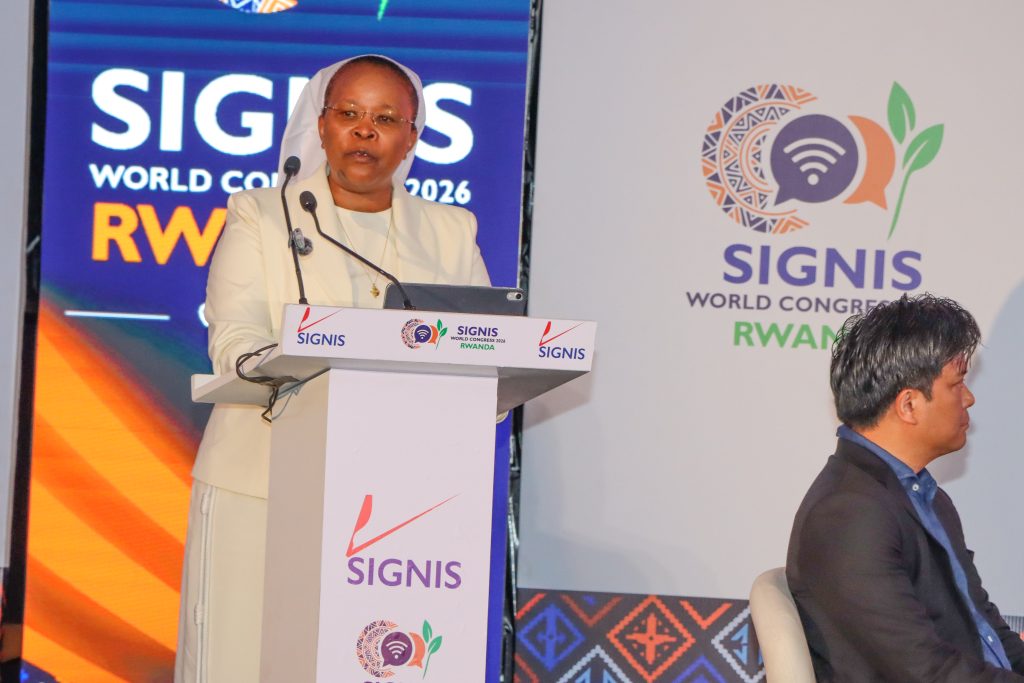
Her contribution comes against growing recognition within the Church of the importance of empowering women religious to strengthen their leadership, communication capacity and contribution to evangelisation and service.
During the Congress, Archbishop Fortunatus Nwachukwu, Secretary of the Vatican’s Dicastery for Evangelization, commended Sr. Jane for her longstanding work in empowering Catholic sisters, particularly through leadership development, capacity building and initiatives that enable women religious to serve their communities more effectively.
The Archbishop described her work as noble and recognised her commitment to creating opportunities for sisters to develop their leadership and contribute more fully to the Church and society.
His acknowledgement reflects the wider contribution of Catholic sisters in evangelisation, education, healthcare, social development and the promotion of human dignity, while underscoring the importance of equipping them to communicate their mission and witness.
It was against this backdrop that Sr. Jane delivered her reflection, “Prophetic Witness in Storytelling and Amplifying the Voices of Catholic Sisters in the Public Square.”
She explored five dimensions of Christian communication: communication as God’s relationship with humanity, communication as a bridge, communication to provide hope, communication to centre those at the margins, and communication as an act of love.
Communication as God’s relationship with humanity
Sr. Jane said communication is deeply woven into God’s relationship with humanity and is more than the transmission of information.
“Communication is not simply the transmission of information. It is woven into God’s relationship with humanity. It creates, reveals, calls, and gives life,” she said.
Drawing from Scripture, she reflected on how God communicates through creation and how Jesus remains the model of authentic communication.
She also referred to the encounters between the angel Gabriel and Mary and between Mary and Elizabeth, noting how the way a message is communicated can shape the feelings and response of those who receive it.
Communication as a bridge
Reflecting on Pentecost, Sr. Jane said communication can transform differences into communion.
“At Pentecost, the Holy Spirit did not erase differences of language or culture. Instead, people from every nation heard the same Good News in their own language. Communication became the bridge that transformed diversity into communion,” she said.
She challenged Catholic communicators to see storytelling as more than publicity.
“For those of us engaged in Catholic communications, storytelling is never merely about publicity. It is an act of service to the Gospel,” she said.
Through storytelling, she added, communicators can help people recognise God’s presence in places where the world often sees only suffering.
Communication to provide hope
Sr. Jane urged communicators to tell stories from the margins in ways that inspire hope, accompaniment and life-giving action.
She shared the story of a young woman whose life had been shaped by hardship from an early age. Married at 13 and later abandoned with three children, the young woman encountered Catholic sisters who welcomed her, cared for her and helped her begin rebuilding her life.
The sisters asked her a question she had never been asked before: “What is your dream?”
Her dream was to become a beautician so that she could make other people feel beautiful.
With the support of the sisters, she received training, established a small business and rebuilt her life. Today, Sr. Jane said, she lives with dignity, her children are in school, she has a home and her future is no longer defined by her past.
For Sr. Jane, the story illustrates the power of hope.
“Our task is not to deny the darkness: our task is to reveal the light that continues to shine within it,” she said.
She cautioned communicators against presenting communities only through stories of crisis, conflict and failure.
“If those are the only stories we tell, we leave the world with an incomplete picture,” she said.
Communication to centre those at the margins
Sr. Jane highlighted the work of Catholic sisters who serve some of the world’s most vulnerable communities.
Sisters educate children who might otherwise never enter a classroom, care for the sick where health systems have collapsed, accompany migrants and refugees, support survivors of trafficking and violence, and remain present in communities affected by war, hunger and natural disasters.
But she stressed that their vocation goes beyond providing services.
“They answer Christ’s Great Commission to ‘go and make disciples of all nations,’” she said.
Their classrooms, clinics, counselling sessions, refugee visits and acts of accompaniment, she explained, are expressions of the Gospel.
“The social impact is extraordinary. But the spiritual witness is even greater,” she said.
Sisters often remain long after the cameras and emergency attention have disappeared because, she said, “God’s love is not seasonal, nor dependent on media attention.”
It was in this context that she delivered one of the most memorable lines of her address:
“Humility should never become invisibility.”
Sr. Jane acknowledged that Catholic sisters have never sought recognition and that their vocation calls them to humility rather than the spotlight. However, she warned that when their stories remain untold, the public square becomes poorer.
She referenced Pope Leo XIV’s call for communicators to ensure that people have “faces and voices”, saying that the lives of Catholic sisters give a human face to the Gospel.
“Their voices remind us that behind every statistic is a person created in the image of God,” she said.
Communication as an act of love
Sr. Jane described storytelling as an act of love when it brings visibility to people who are often overlooked.
“Storytelling becomes an act of love when it refuses to leave people in that darkness. It becomes an act of justice when it gives voice to those who are rarely heard. And it becomes an act of evangelization when it helps others encounter Christ through the witness of His disciples,” she said.
She urged communicators to do more than report events.
They must discern where the Holy Spirit is already at work, recognise wisdom where others may see only obscurity, and amplify voices that reveal both human resilience and God’s enduring presence.
Communication as ministry
Sr. Jane also highlighted the Pentecost Project, implemented by the Vatican’s Dicastery for Communication, and Wisdom Calls, implemented by SIGNIS, describing them as important initiatives for strengthening the voices of Catholic sisters.
She said the projects demonstrate that communication itself can be a ministry.
“When we amplify authentic voices, we build bridges between communities. When we tell stories responsibly and truthfully, we cultivate solidarity. When we allow those living on the margins to speak for themselves, we restore dignity,” she said.
Reflecting on her experience supporting the African Sisters Education Collaborative, Sr. Jane recalled how investment in the education of Catholic sisters across more than ten African countries has produced impact far beyond the sisters themselves.
Educated sisters have gone on to educate children, manage hospitals, lead schools, accompany vulnerable families, conduct research, advocate for justice and build stronger communities.
Yet, she noted, many of these stories remain unknown.
For Sr. Jane, this is why Catholic communicators have an important responsibility: to make visible the quiet work of faith, service and transformation taking place around the world.
She concluded by calling communicators to tell stories with love, faith, hope and courage, and to work for the common good.
“Because when their stories are heard, the Church is better understood. When their witness is seen, Christ becomes more visible. And when Christ becomes more visible, hope becomes contagious,” she said.