
KIGALI, Rwanda.
Catholic schools have been challenged to ensure that the growing use of artificial intelligence does not replace personal reflection and authentic spiritual expression among learners.
Speaking during the SIGNIS World Congress in Kigali, Sr. Mary Santrina Tumusiime, CJ, a member of the Communications Network for Catholic Sisters (CNCS) in Kenya, explored how artificial intelligence is influencing prayer and spiritual formation in Catholic schools, particularly as students increasingly turn to generative AI tools to produce content.
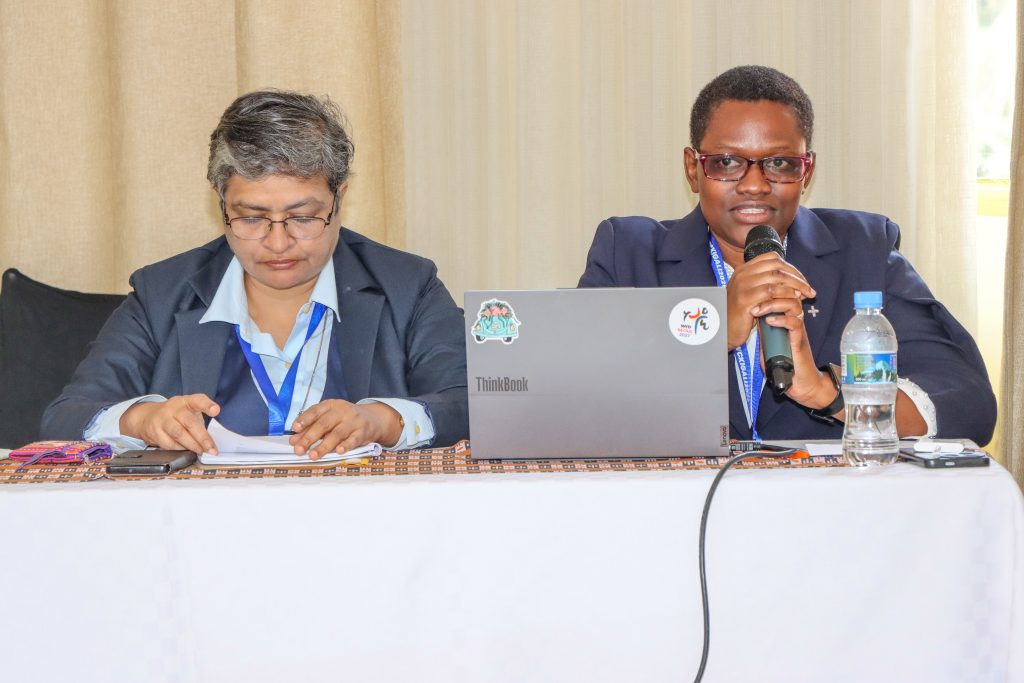
Her presentation, “AI Enhancing Cultural Harmony in Catholic Schools,” examined a fundamental question: Can prayer remain authentic when its language is increasingly generated by artificial intelligence?
The presentation came within the wider Congress reflection on digital communication for communion, equity and environmental wellbeing, highlighting the need to ensure that technology serves human dignity and authentic human relationships.
AI and the originality of prayer
Sr. Mary Santrina focused on an aspect of artificial intelligence that is sometimes overlooked: its impact on the originality and authenticity of prayer.
In Catholic schools, prayer is part of the culture and contributes to the holistic formation of students from different backgrounds, denominations and cultural experiences.

She explained that the challenge is no longer simply whether AI should be used, but how it can be used without diminishing students’ spiritual development.
“We are in an era of instant generation,” she said, noting that content can be produced with a simple click.
While some generated content may be useful, she cautioned that the convenience of instant generation can leave little room for thinking, exploration and reflection.
“The growing dependence on generative tools threatens the gradual displacement of the interior life by technological convenience,” she said.
“What are we losing?”
Sr. Mary Santrina recalled an experience while facilitating a pastoral session with students aged around 12 and 13.
She had asked the students to reflect and write an honest prayer of thanksgiving based on their own experiences.
One student, struggling with the exercise, asked whether she could use AI to generate the prayer.
The question prompted a deeper reflection for Sr. Mary Santrina.
“I invited them to write a prayer from an honest experience. But she immediately thought about an alternative that was not going to involve thinking. What is this going to cost us?” she asked.
The experience led her to formulate the central question of her presentation:
“Can prayer remain authentic when its language is increasingly generated by artificial intelligence?”
She argued that the concern is not simply about the words produced by AI, but about what may happen to the personal reflection and spiritual interiority that should accompany prayer.
AI-generated prayers may contain beautiful language and correct grammar, she noted, but students may quickly forget the words because they do not necessarily emerge from their own experiences.
AI can imitate prayer, but it cannot pray. The student must personally engage in prayer from the heart.
Composition versus communion
The presentation distinguished between originality of composition and originality of communion.
Originality of composition can focus on producing beautiful words, polished language and impressive prayers.
But Sr. Mary Santrina asked what connection those words have with the actual experiences and lives of students.
Originality of communion, on the other hand, involves students connecting with their own experiences and expressing an honest prayer from the heart.
She noted that traditional Catholic prayers such as the Our Father and Hail Mary retain their meaning because they are rooted in a shared faith tradition and communal practice.
The concern arises when AI-generated language becomes a substitute for the student’s own reflection and encounter with God.
She also contrasted religious content with spiritual encounter. While AI can provide religious content, authentic prayer involves relationship, contemplation, vulnerability and transformation.
AI-generated prayer can therefore become product-focused—concerned with beautiful words, correct grammar and instant production—while authentic prayer is process-focused, requiring reflection, personal experience, relationship and gradual transformation.
From authenticity to transformation
To help Catholic schools think about authentic prayer in the age of AI, Sr. Mary Santrina proposed a framework centred on authenticity, interiority, communion and transformation.
The process begins with authenticity, allowing students to connect with real experiences.
It moves to interiority, encouraging them to reflect deeply on those experiences and ask what they mean.
From there comes communion—sustaining a dialogue with God and recognising one’s relationship with others.
The final stage is transformation.
She explained that transformation enables students to live together with people of different backgrounds, including Catholics and non-Catholics, believers and non-believers, while appreciating different perspectives and cultures.
In this way, authentic prayer becomes more than the production of words. It becomes part of a process that can contribute to cultural harmony within Catholic schools.
Prayer, discernment and the human person
Sr. Mary Santrina further connected authentic prayer with the Church’s emphasis on listening and discernment.
While AI provides immediate and convenient answers, spiritual discernment requires time, silence, reflection and openness to the Holy Spirit.
She cautioned that young people who become accustomed exclusively to instant technological responses may lose confidence in the slower contemplative process through which they learn to listen and discern.
Authentic prayer, she explained, requires an interior journey and a willingness to be vulnerable before God.
Drawing on the biblical invitation to “pour out your hearts” before God, she contrasted authentic prayer that comes from within with the possibility of words being generated externally and simply “poured into” the person.
This, she said, can create a disconnect between the praying person, God and the surrounding community.
Human dignity, she emphasised, must remain at the centre of the use of technology. Artificial intelligence should serve authentic human flourishing rather than diminish the unique vocation and dignity of the human person.
AI should not simply be prohibited
Despite her concerns, Sr. Mary Santrina did not call for the rejection of artificial intelligence.
AI can be used as a resource for learning prayers, improving language and helping students understand religious content.
The challenge, she said, is to develop digital discernment and ethical integration, ensuring that technology supports rather than replaces human formation.
Catholic educators should prioritise human presence and genuine encounter while helping young people cultivate contemplative habits, reflect on their lives, understand themselves and appreciate others.
Young people also need to be encouraged to embrace silence and vulnerability, even when reflection becomes uncomfortable.
Technology, she stressed, should remain a servant of evangelisation, never a substitute for the human encounter at the heart of faith.
Forming disciples, not just content generators
The challenge for Catholic schools is therefore not simply how to regulate AI, but how to form young people who can use technology responsibly while retaining their capacity for reflection, prayer, discernment and genuine human relationships.
As AI increasingly shapes how young people communicate and learn, Sr. Mary Santrina left Catholic educators with a question that captures the heart of her presentation:
“As artificial intelligence increasingly shapes how young people communicate, are Catholic schools forming students who can merely generate beautiful prayers, or disciples who genuinely know how to pray?”